
Onward Towards Our Noble Deaths [1991] by Shigeru Mizuki – ★★★★1/2

The most astonishing and touching aspect of this graphic novel is that it is based on Shigeru Mizuki’s own experience of being a soldier in the Imperial Japanese Army during the World War II, an event that affected him deeply, haunting him incessantly throughout his life and influencing his pacifist views.
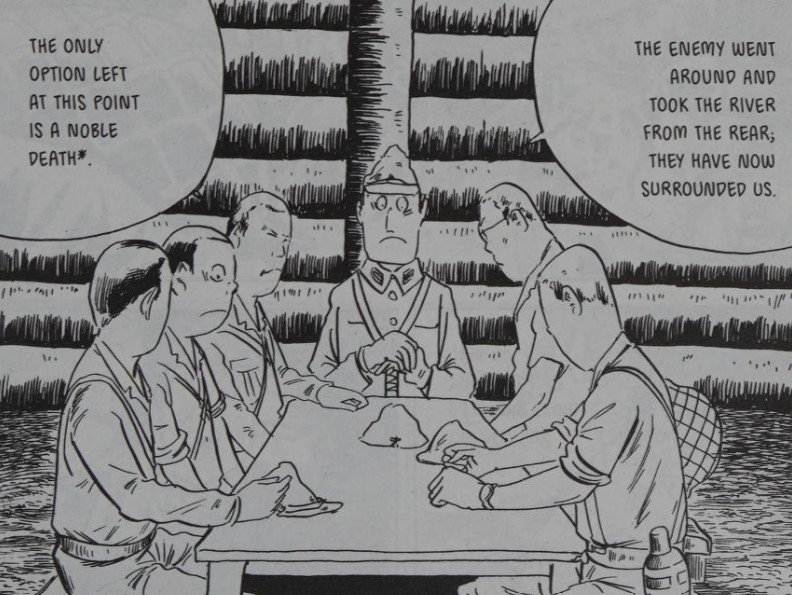
Papua Guinea (New Britain), 1943. One unit of the Japanese Imperial Army finds itself cornered by the enemy, rapidly succumbing to starvation, dengue fever and hopelessness. On top of it all, the soldiers receive beatings and bullying from their superiors, and their brutal disciplinary regime is informed by one misguided chain of command and the army’s inflexible hierarchy. “New recruits are like tatami mats, the more you beat them, the better they are” – seems to be army commander’s credo. We see the perspective of one rookie soldier who is thrown in at the deep end into the new environment, and is forced to adapt quickly to the most absurdist directions from his superiors regarding the war, including orders to perform “noble suicides”. This tale of one doomed regiment is very simply drawn, including the characters, but most of the backgrounds are very detailed, perhaps further underlying the Japanese militarism’s idea of the inconsequential nature of individual lives, especially vis-à-vis the Emperor and the sense of “honour”.
Onward Towards Our Noble Deaths is an unflinching look at the war in all of its dehumanising aspects, and would go well with Shōhei Ōoka’s Fires on the Plain, another harrowing anti-war book that considers the crippling war efforts of the Japanese at the end of the World War II.
<< Buy Onward Towards Our Noble Deaths (affiliate link) >>


Trashed [2002/2015] by Derf Backderf – ★★★★1/2
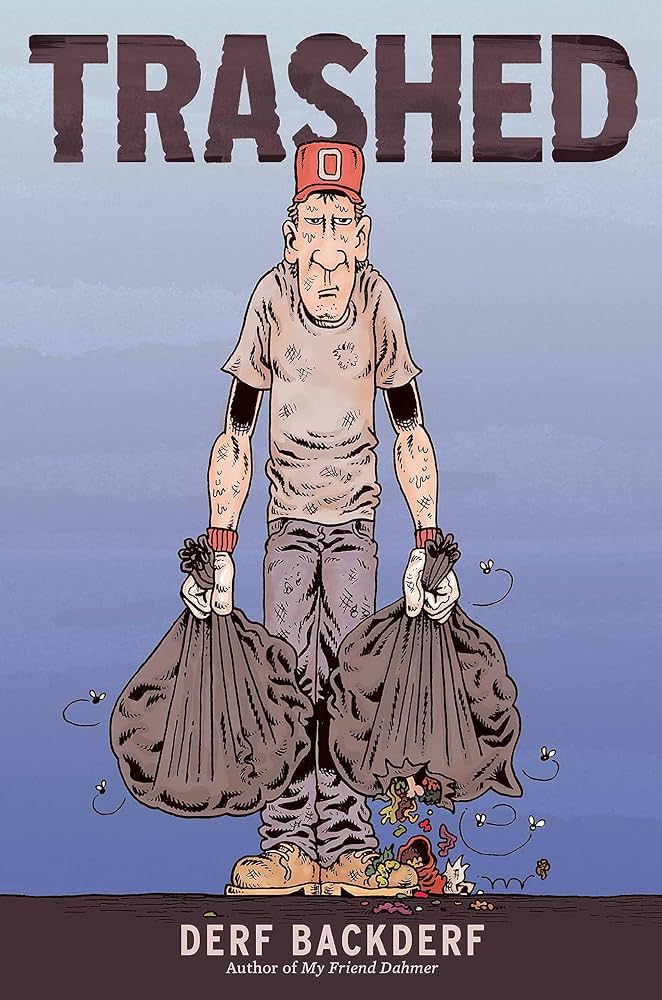
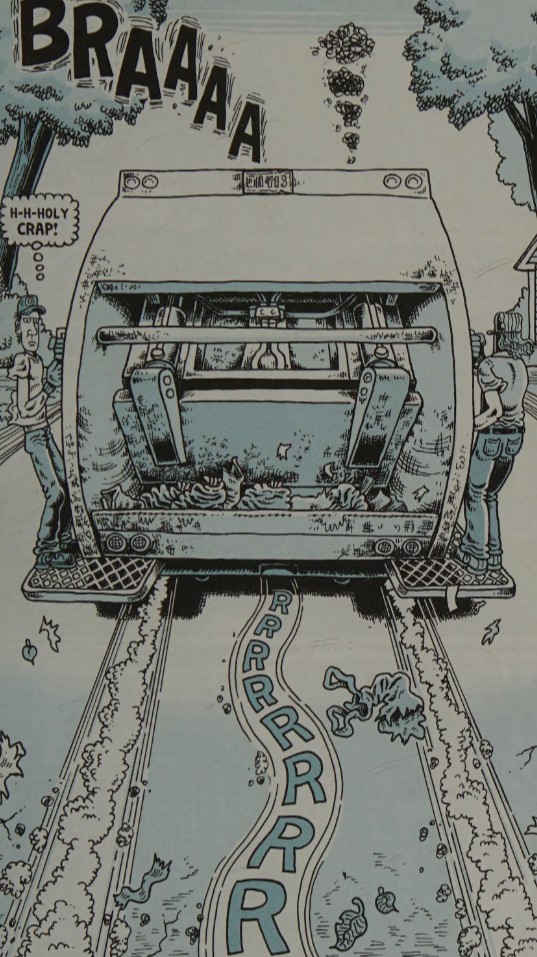
Books that shed light on little known or “undesirable” jobs are always something special. Trashed provides an insight into all the nuts and bolts of garbage-collecting, inspired by the author’s own work experience in 1979 and 1980. Our protagonist is twenty-one-year-old, jobless JB, who, out of sheer desperation, goes for a garbageman apprenticeship, an experience which he soon finds hectic and stressful, but which also teaches him valuable life lessons. He meets “illustrious” characters in his job, who are all destined “for a higher calling”, and deals with such things as the prejudice attached to his job, and picking up as trash such things as animal corpses and immovable furniture. “You lose your idealism fast on this job. Garbagemen only have to concern themselves with this…people put trash out on the curb…we pick it up. Day after day. Week after week. Year after year…and it never stops coming!”, he learns.
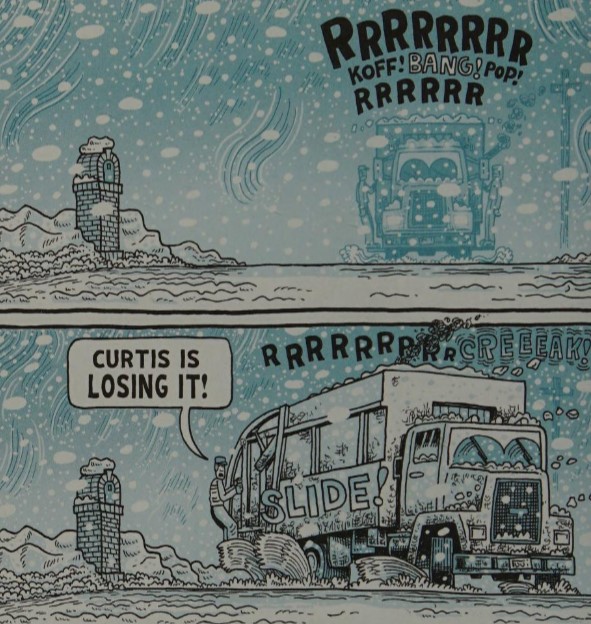
Every other page also provides interesting historical, encyclopaedic information on garbage-collecting and landfills. For example, did you know that if the US starts dumping all its trash in one landfill and does so for one year, that landfill already has to be at least 400 feet deep and more than 1000 square acres (Big Ben is 315 feet tall), and there are already several landfills that are at least 400 feet deep in the country? The detailed illustrations are a delight to follow, and overall, Trashed is a fun reading experience filled with many amusing moments and insights into blue-collar grind.
<< Buy Trashed (affiliate link) >>

 Thoughts on Papyrus
I find many graphic novels are able to convey a presentation of difficult topics through this genre. Thanks for writing about these two.
LikeLiked by 1 person
Thanks for stopping by and reading, and I agree. Images can definitely convey the necessary emotions pertaining to these traumatic topics. An image paints a thousand words, or so the saying goes.
LikeLike
Thanks for the reviews. I have yet to try any graphic novels. I think I should.
LikeLiked by 1 person
My pleasure! Then you are in for a treat, I think – some are real gems and even open up subjects like no ordinary non-fiction could. Shigeru Mizuki’s NonNonBa is also delightful. It explores a child’s experience with the spirit world, and the one that set me on the path to Japanese manga was probably Tekkonkinkreet by Taiyo Matsumoto (the animation is also great). Drawn & Quarterly in general publishes thought-provoking graphic novels: Year of the Rabbit, Clyde Fans and Red Snow are just a few that I have read and recommend. It all depends on personal interests, of course, but there are also some by Yoshihiro Tatsumi and Jacques Tardi on my TBR.
LikeLiked by 1 person
Thank you for the recommendations!
LikeLiked by 1 person
Combining a bit of both – Japanese autobio and tough job (cleaning the nuclear waste at Fukushima), I highly recommend this nonfiction graphic “novel”:
Ichi-F: A Worker’s Graphic Memoir of the Fukushima Nuclear Power Plant, by Kazuto Tatsuta
LikeLiked by 1 person
Thanks very much! That’s indeed very fitting, just added it to my TBR list!
LikeLiked by 1 person