

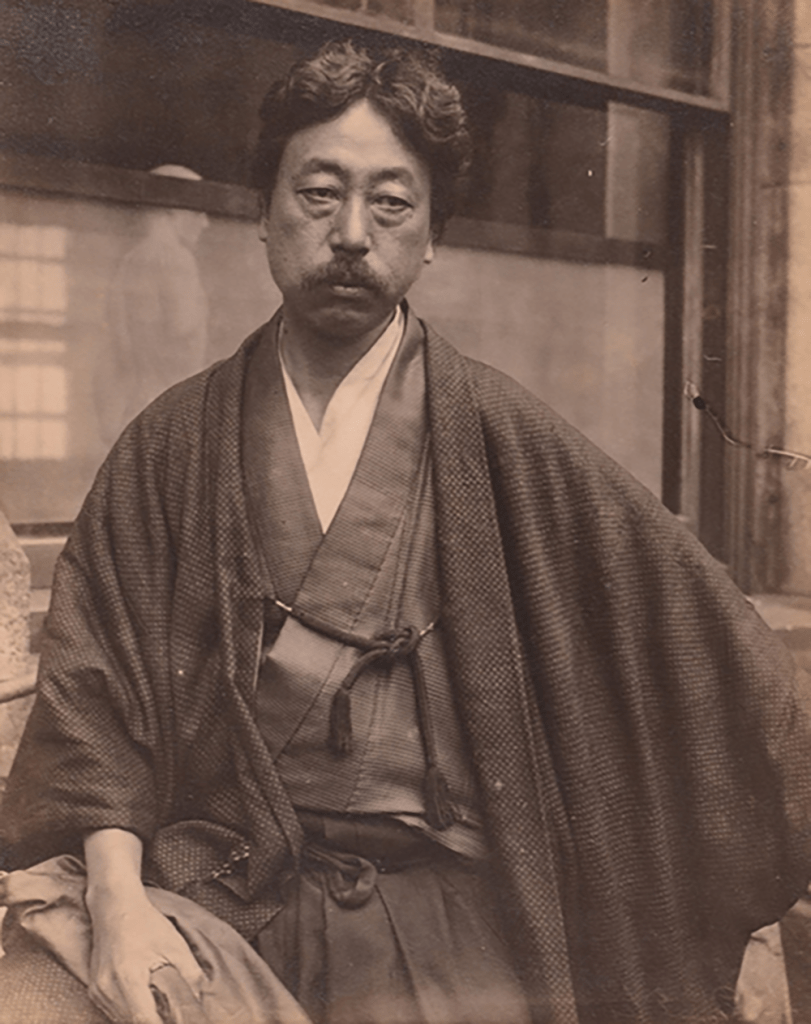
Kakuzō Okakura (1863 – 1913) was a Japanese scholar and art critic who defended core Japanese ideals, traditions and customs in the era of Meiji Restoration Reform. His major written work titled The Book of Tea [1906] distils the meaning and finer elements of the Japanese tea ceremony (“…the whole ideal of Teaism is a result of the Zen conception of greatness in the smallest incidents of life…”), but the book is not only about the tea ritual, and there are many insights offered in the book on life and death, Zen Buddhism, art, aesthetics, drama, and architecture, among other topics. Below are just a few quotes from this thought-provoking essay-book.
On the nature of art:
“In religion the Future is behind us. In art the Present is the eternal...”
“...art is of value only to the extent that it speaks to us. It might be a universal language if we ourselves were universal in our sympathies. Our finite nature, the power of tradition and conventionality, as well as our hereditary instincts, restrict the scope of our capacity for artistic enjoyment. Our very individuality establishes in one sense a limit to our understanding, and our aesthetic personality seeks its own affinities in the creations of the past. It is true that with cultivation our sense of art appreciation broadens, and we become able to enjoy many hitherto unrecognised expressions of beauty. But, after all, we see only our image in the universe, – our particular idiosyncrasies dictate the mode of our perception. The tea masters collected only objects which fell strictly within the measure of their individual appreciation“.
On drama:
“The (drama) masters are immortal, for their loves and fears live in us over and over again. It is rather the soul than the hand, the man than the technique, which appeals to us. – the more human the call the deeper is our response. It is because of this secret understanding between the master and ourselves that in poetry and romance we suffer and rejoice with the hero and heroine. Shikamatsu, our Japanese Shakespeare, has laid down as one of the first principles of dramatic composition the importance of taking the audience into the confidence of the author”.
Kakuzō Okakura also articulated the value of a “vacuum” and the “power of suggestion” in art/drama:
“…in leaving something unsaid the beholder is given a chance to complete the idea and thus a great masterpiece irresistibly rivets your attention until you seem to become actually a part of it. A vacuum is there for you to enter and fill up to the full measure of your aesthetic emotion.“
 Thoughts on Papyrus
“It is true that with cultivation our sense of art appreciation broadens, and we become able to enjoy many hitherto unrecognised expressions of beauty. ”
How true! I just posted about this recently
LikeLiked by 1 person
The book looks as beautiful as it it interesting
LikeLiked by 1 person
I also enjoyed this book a lot. So rich, in so many respects.
LikeLiked by 1 person
This is a lovely book. Brief but leaves you with much to think about. I love those quotes you’ve chosen. So true.
LikeLiked by 1 person
I recently discovered this book and loved it! Short but packed with wit and insight. Very idiosyncratic as well.
LikeLiked by 1 person
I need to spend more time on this site! Excellent work!
LikeLiked by 1 person
In writing novels, it is recommended to leave about half up to the reader – and every reader gets a different book, depending on what is in their mental database to be used to complete the story. Telling a reader everything would be rude.
LikeLiked by 1 person
It definitely sounds so very right and true, and I wish some recent releases also took notice of this. I have been reading a number of “over-written” books recently.
LikeLike
It’s such a beautiful book. Whenever anyone asks me for tea book recommendations I always tell them to read this one if they haven’t already
LikeLiked by 1 person