
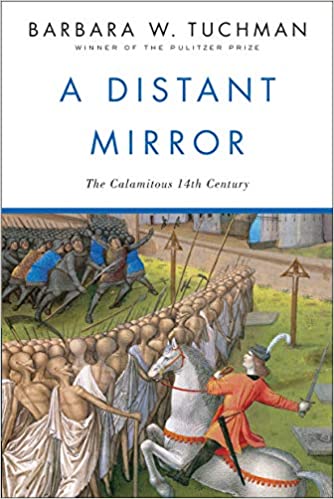
A Distant Mirror: The Calamitous 14th Century [1978] – ★★★★★
In this book, Barbara Tuchman explores the 14th century Europe focusing in particular on the situation in France and on the powerful clan of lords – the Coucy of Picardy, whose ambition at that time almost rivalled that of the King. The centre of the narrative here is the lifetime of Enguerrand VII de Coucy, whose double allegiances and adventures could be compared to some mythical storytelling. Providing vivid insight into various aspects of the medieval life, from childhood to tournaments, and from the state of medicine to the status of women, Tuchman’s book makes one step truly into the intriguing world of the Middle Ages and into the mentality of its people. This was a historical period that was deeply paradoxical and chaotic, in which famine, peasant revolts, foreign wars, the bubonic plague and religious struggles were all taking place in a non-stop succession amidst the existence and the proclamation of the high moral code of chivalry among the nobility, and where magic and superstition reigned inexplicably alongside one strict religious canon.
The book opens with the description of the castle of Coucy in Picardy, northern France, a magnificent structure, which showcased the extent of the power of the clan of Coucy in the region in the 14th century: “the Coucy maintained a sense of eminence second to none and conducted their affairs after the usage of sovereign princes” [Barbara Tuchman, 1978: 14]. This was a time of complex political ties and confrontations between England and France, with their allegiances and territories mingled. A curious situation arises involving Enguerrand VII de Coucy, a distinguished French Knight, who acquired a double allegiance when he married Isabella, the daughter of the King of England, only to forsake this allegiance and fight for the French later in his life.
Although we follow the French history and the Coucy in Tuchman’s book, the text often makes excursions onto general topics of interests, commenting on this or that fascinating aspect of medieval history. Perhaps we never get bored with Tuchman’s book because she is not a traditional historian, but a self-taught one, being a writer first. This gives her plenty of confidence to pick and choose the most fascinating aspects of the 14th century, and she slides with ease and grace into the most illustrious periods in that century, making her narrative engaging and exciting to read.
Below, I will briefly comment on the following four aspects from her book: (i) Domestic Life, Chivalry & Magic; (ii) State & Religion; (iii) Foreign Wars & Internal Struggles, and (iv) The Black Death.
- Domestic Life, Chivalry & Magic
A Distant Mirror opens to us a journey not only into the Middle Ages, into that distant land full of fragmented power, magic and superstition, but also into the medieval mind and mentality of people living at that time. In the book, I particularly appreciated the various insights into the peculiarities of the domestic life of men and women living in the medieval period. Tuchman writers that “except for hermits and recluses, privacy was unknown”, and “common hands” usually formed brotherhoods “which surrounded [them] at every crux of life”, from birth to death [1978: 40].
Attitudes towards children at the time are even more interesting. Attachment to children was virtually non-existent or very negligible, and child-rearing was left almost to chance. That slight attention is evidenced in the arts and literature of that time from which children are almost absent. The author makes a point that this may be due to the fact that deaths of infants were common and pretty much expected, and, this, coupled with frequent child-bearing, meant that love and attachment to children were discouraged since both would, more likely than not, prove to be meaningless in the end and only lead to the experience of sorrow upon sorrow. However, “if children survived to the age of seven”…”their recognised life began, more or less, as miniature adults” [1978: 52].
Tuchman then makes the following observation: “possibly, the relatively emotional blackness of a medieval infancy may account for the casual attitudes towards life and suffering of the medieval man” [1978: 52]. However, in my opinion, that “casual attitude towards life” has a more straightforward explanation and that is the simple fact that death itself was so common and present everything, contributing to the development of a fatalistic attitude in people. People were born to believe that their life is predetermined on this earth. And then, why even be afraid, cautious and serious about something you normally expect and see almost on a daily basis? It does not make sense to be so cautious, and, in fact, one should be fairly fearless and relaxed in the face of death and ever-present danger so as to simply live a relatively normal life, which is never expected to be a long one anyway.

Chivalry denotes an informal code of conduct that was associated with the medieval Christian institution of knighthood, and was meant to govern knights’ behaviour and social etiquette. Tuchman’s insights here are also illuminating. She writes that “the system of chivalry was based chiefly on illusion to make knight’s behaviour in accordance with the church doctrine” [1978: 163], and that “the war between England and France, [including the] brigandage it spawned, revealed the emptiness of chivalry’s military pretentions and the falsity of its moral ones” [1978: 556].
Few people realise the extent to which the medieval society was steeped in magic, superstition and folklore, and this was all paradoxically happening when the power of religious devotion and the belief in the Scripture were very high, indeed. Tuchman writes that “alchemy, or the search for the philosopher’s stone that would transmute bare metals into gold, was the most popular applied science”, and that “magic was present in the world”, with “astronomy [being] the noblest science, and astrology, after God, the greatest determinant of affairs” [1978: 55]. The medieval society was so superstitious and religious that one’s place in either Hell or Heaven was as certain as the Sun rising tomorrow, and the Garden of Eden was as realistic as one’s own farm land.
- State & Church
A Distant Mirror makes us appreciate that the society back then was very different from the society and the state as we know it now. The status of nobility was in “flux”, and the modern state, as we know it, did not yet exist: there was “the vassal-to-lord relationship and not citizen-to-state” [1978: 5]. The “medieval political structure was ideally a contract-exchanging-service”, and loyalty was given in return for protection, justice and order [1978: 16]. In theory, the nobility was tasked with the protection against tyranny and had a goal to fight against the oppressor, as well as cultivate virtues. The strict hierarchy meant that everyone knew their place: “the clergy had to pray for all men, the knight to fight for them, and the commoner to work that all might eat” [1978: 24]. This also meant that there were strict rules of dress in place so that people’s societal statuses could be easily discerned.
Tuchman’s book then tells of the rise of papal Avignon, and details the schism in the second half of the century. That schism “shook the foundations of the central institution…spreading pervasive uneasiness among the people” [1978: 36]. Even though challenges to papal supremacy were coming and going throughout the century, the Church occupied such a central part in everyone’s life, that there was always high respect/obedience with regards to all religious matters, especially since the Church was the “only institution” to offer salvation, and it also “affirmed the man’s life on earth” [1978: 34]. In that vein, even though there were “priests” who were incompetent and corrupt, willing to sell pardons and absolutions at a moment’s notice, the veneration towards anything religious persisted: “friars were an element of daily life, scorned, yet venerated and feared because they might, after all, hold the key to salvation” [1978: 39].
- Foreign Wars & Internal Struggles
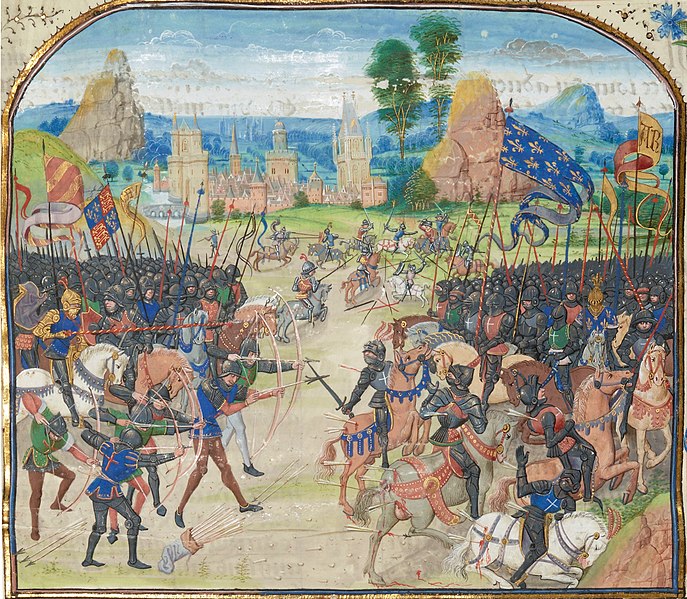
Most of the Hundred Years’ War took place in the 14th century, and Tuchman talks in her book about the difficult geopolitical situation between England and France at that time, drawing attention to the Battle of Poitiers of 1356, to the anarchy after the Battle of Poitiers, to the tricky situations in Italy and in Flanders, to the military conflicts with the Ottoman Empire, and, finally, to the Battle of Nicopolis in 1396. While vividly describing the battles, Tuchman gives insights into the psychology of warfare at the time: “Medieval wars between Europeans were not aimed at strategic conquests”, writes the author, “but rather at seizure of dynastic rule at the top by inflicting enough damage to bring about the downfall of the opponent” [Tuchman, 1978: 180].
The internal lawlessness was also prevalent, especially after 1376, when the Statute of Labourers meant that the wages of farmers remained those of pre-plague years. Tuchman talks about the new “Robin Hood” lawlessness that descended on the country after that period, fuelled also by the general feelings of the futility of wars: “England caught the contagion of lawlessness which the war has spread across the continue” [Tuchman, 1978: 285], the author writers, saying that the “whole generation accustomed itself to brigandage”, with the breakdown of justice following and the legend of Robin Hood gaining the greatest popularity at that period.
- Black Death
The Black Death has been called “the pestilence”, “the bubonic plague” and “the great mortality”. The disease (advanced by the Yersinia pestis bacteria) spread faster than fire across Europe from 1347, with victims displaying surprising symptoms that only confused and bewildered those who wanted to ascertain the cause and progress of the mysterious disease. In her book, Barbara Tuchman not only emphasises the recurrent nature of the plague (for example, it returned in 1361) and the incapability of the then medicine to handle the problem, but also tries to demonstrate the long-term effects of the plague on medieval society and mentality of people, including its effect on economy and on the people’s worldview. It is admirable the skill with which the author stays so detailed and yet so comprehensive in her narrative, striking a delicate balance between giving broad historic information, on the one hand, and personal and immersive stories, on the other.
🐲 The Middle Ages present a fascinating conundrum in the history of mankind since it was the period of immense losses, violence and stagnation while, at the same time, there reigned in the land the idea of the chivalric behaviour worthy of every admiration, and religious devotion and loyalty to masters like few periods have seen before or since. At no other historic period, the theory and practice of living have been in a greater discord, and Tuchman comments and elaborates on these paradoxes in such an immersive manner that her readers often find themselves in the midst of all events and actions, in the vicinity of battles and inside the domestic life of medieval men and women. Reading history has never been as entertaining as with this book by Tuchman.
 Thoughts on Papyrus
I really enjoyed this book when I read it 🙂
LikeLiked by 2 people
I read this 40 or so years ago and you remind me of what I liked about it.
LikeLiked by 1 person
Absolutely stunning and brilliantly-structured review. I am intrigued by how insightful it is on iconic historical events, giving insight on how humankind strived to overcome tragedies, e.g. Black Death. Thank you for sharing. 🙂
LikeLiked by 1 person
Thank you very much! I am glad you loved the post.
LikeLiked by 1 person
I am very intrigued by this! Though I’m a bit wary that Tuchman is not a historian… I love books about Medieval times by Jacques le Goff, I’d argue that to date there was no better historian of Middle Ages than him – and Annales school of history, i.e. social/cultural history, is to me the most important perspective we can take on the past. But your review makes me want to pick up Tuchman’s book and see for myself – so thank you! 😀
LikeLiked by 1 person
I will look into Le Goff books, thanks a lot for this recommendation, and I highly recommend this book by Tuchman. I think it helped her that she was not talking about the whole of the Middle Ages but just a century, and focused in particular on the life of Enguerrand VII de Coucy. This made her narrative often read like an exciting story or myth set at this specified time, rather than this broad historic narrative of the Middle Ages. The result is that this is probably one of the most engaging history non fiction books I have ever read.
LikeLiked by 2 people
Thanks for your in-depth review. I read this about 10years ago, and thoroughly enjoyed it. In my own review (totally pathetic compared to yours), I explained that focusing on Enguerrand was clever. I’m surprised you didn’t mention antisemitism – nothing new under the sun!!
If you are curious, my review is here: https://wordsandpeace.com/2011/05/10/a-distant-mirror/
LikeLiked by 1 person
Focusing on Enguerrand was indeed clever. I cannot recall when was the last time I enjoyed a history book more. I am now reading Tuchman’s The March of Folly: From Troy to Vietnam and I hope it will be equally good.
LikeLike
I honestly don’t know much about the 14th century, so this book looks really interesting. And I do love books about history that are entertaining! Besides, reading about the Black Death reminds me that Covid isn’t that bad, lol. I’ll definitely put this book on my TBR.
LikeLiked by 1 person
The Black Death was terrible. I hope you like the book when you get a chance to read it.
LikeLiked by 1 person
Oh this looks so interesting thank you for your comprehensive and compelling review Diana. This sounds right up my alley and is now firmly on my TBR list and I’m looking where I can get a copy. I hope you are doing well, take care 😘
LikeLiked by 1 person
I hope you enjoy the book, and doing good too! 🙂
LikeLiked by 1 person
Tuchman is one of my favorite historians. She writes like a novelist. I’ve re-read both The Guns of August and The March of Folly countless times.
LikeLiked by 1 person
Very well-said – she writes like a novelist, so true! I have only recently finished The March of Folly and really liked it!
LikeLike